Post-show conversion
A Complete Card-Show Follow-Up Email Sequence
A useful post-show sequence reconnects the conversation, fulfills the booth promise, helps the collector make progress, and presents a relevant next step without sending five versions of the same sales pitch.
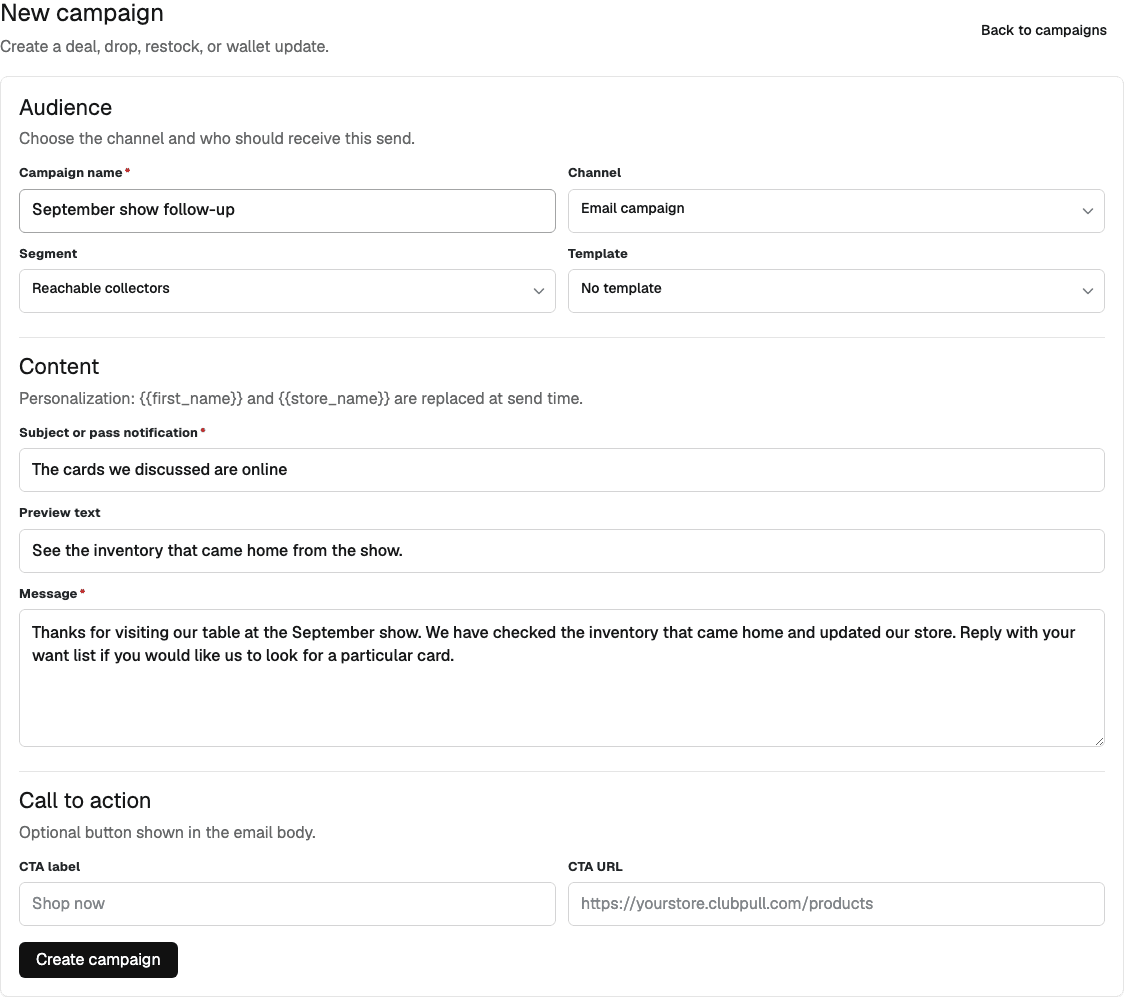
Build the sequence around one continuing conversation
The collector should not feel as if a stranger acquired their address. Every email needs to connect naturally to what happened at the booth: the resource requested, the inventory discussed, the want list shared, or the event where you met. That continuity is more important than clever subject lines.
Separate the immediate delivery message from the promotional sequence. Someone who requests a checklist should receive it even when they do not select the optional marketing checkbox. Only schedule the later messages for people who explicitly chose recurring updates. The email consent guide shows how to keep those two purposes clear.
Before writing, define the one outcome you want from the sequence. It might be a reply with a want list, a visit to a show inventory page, a first online purchase, or registration for the next drop. One sequence can support several actions, but it should not ask for all of them in every message.
Replace every bracketed detail before sending. These are synthetic examples. Use the promotional examples only for recipients who opted in to marketing.
Email 0: deliver the promise immediately
Send the resource, credit, storefront link, or membership confirmation as soon as the form is submitted. This message is transactional in purpose. Make it easy to recognize and easy to use.
Subject: Your card-show checklist from Northside Cards
Opening: Thanks for stopping by our table at the August collector show. Here is the checklist you requested.
Body: Put the promised link or code in the first screen. Add one sentence about what it contains, a support reply address, and the seller name. Do not bury delivery below a promotion. If the item is a download, include a normal web page fallback in case an email client blocks the attachment.
Primary action: Open the requested item.
Test this email before the show using a real phone on cellular data. Confirm the sender name, subject, link destination, mobile layout, and reply address. A request that arrives instantly creates confidence while the booth interaction is still fresh.
Subject: Your [resource] from [seller name]

Thanks for stopping by our table at [show name]. Here is the [resource] you requested:
[resource link]

If the link does not open, reply here and we will help.
[seller name]
[reply address]
Email 1: reconnect the booth conversation
Send this within the window described in the follow-up timing guide, usually later that day or the next morning. The message should prove that you know why the person signed up.
Subject: Good meeting you at the card show
Opening: Thanks for talking vintage baseball with us yesterday. You mentioned working on the 1975 set, so I saved the page where we will post the remaining cards.
Body: Use one genuine detail when it was captured with permission. If you do not have a conversation note, reference the event and the exact signup offer instead. Give one helpful next step. For example, ask the collector to reply with three missing card numbers, or link to the category they scanned for.
Primary action: Reply with a want list or visit the relevant page.
Do not fake personalization. An inaccurate player, set, or purchase reference is worse than a short honest message.
Subject: Good meeting you at [show name]

Thanks for visiting our table. You signed up for [the offer shown at the booth].
Here is the page for [relevant collection]: [storefront link]

Looking for a particular card? Reply with your want list and we will check.
[seller name]
[postal address]
[unsubscribe link]
Email 2: teach one useful lesson
Send this around day three. Choose a problem close to the inventory or service you provide. A vintage seller could explain how they organize a set want list. A TCG seller could share a short pre-release preparation checklist. A memorabilia seller could explain what provenance details they document.
Use a compact structure:
- Name the collector problem.
- Give three practical steps.
- Show a concrete example.
- Link to a complete guide or tool.
- Invite a reply if the reader is stuck.
The lesson should be valuable without a purchase. That does not make it weak marketing. It demonstrates judgment, gives the reader a reason to keep opening, and makes the later product recommendation easier to trust.
Primary action: Use the lesson, tool, or checklist.
Subject: A simpler way to share your [set name] want list

Keep the set name, card number, and preferred condition together. Mark which cards you still need, then send the list in one message. It makes matching much easier.

Reply with your list if you would like us to check our inventory.
[seller name]
[postal address]
[unsubscribe link]
Email 3: present inventory or a bounded offer
Around day six, connect the show interaction to a product, collection, or clearly defined offer. Do not send the entire catalog. A narrow selection helps the reader decide.
Subject: The vintage baseball cards we discussed are online
Body: Explain why these items are relevant, show a small number of examples, and state important conditions directly. If you use an incentive, include the value, minimum purchase, exclusions, and expiration. The post-event offer guide includes margin checks and alternatives to discounts.
For inventory that returned from the show, organize it by the way collectors shop: player, team, set, game, condition, price range, or product type. The unsold inventory playbook explains how to turn booth context into a focused online collection.
Primary action: Shop one relevant collection or reply for a match.
Subject: Our remaining [show name] inventory is online

We have reconciled the cards that came home from the show. You can see current availability and prices here:
[relevant collection link]

Questions about condition? Reply before ordering and we will help.
[seller name]
[postal address]
[unsubscribe link]
Email 4: invite the next relationship step
Send this around day twelve to fourteen. The goal is not a final warning. It is a clear invitation to remain connected through the next real event in your selling calendar.
That next step could be:
- early access to a scheduled inventory drop;
- a reminder for the next local show;
- membership with clearly described benefits;
- a wallet pass for points or seller updates; or
- a request to update a want list.
State what will happen and when. "Join our community" is vague. "Get the link Friday at 6 p.m. Eastern before the vintage drop opens at 7" is operationally clear.
Primary action: Save the date, join the defined program, or update preferences.
Subject: See what is next at [seller name]

Our next [show or inventory drop] is [date]. Details are here: [event or collection link]

You are receiving this because you opted in at [show name]. If these updates are no longer useful, you can unsubscribe below.
[seller name]
[postal address]
[unsubscribe link]
Segment without building a maze
Start with a few attributes you can act on: source event, inventory interest, customer status, marketing consent, and whether the person has purchased since the show. These support useful branches:
- Buyers can receive care, complementary inventory, and loyalty guidance.
- Non-buyers can receive a lower-friction way to browse or share a want list.
- People who clicked one category can receive that category, not a generic blast.
- People who replied should leave automation and enter a human conversation.
- Unsubscribed or suppressed contacts should receive no further marketing.
Use event-specific UTM parameters on email links. Google Analytics documents the
standard campaign fields, including source, medium, and campaign. Keep a stable
naming convention such as source=postshow, medium=email, and a campaign value
based on the event and date. Attribution should help compare sequences, not expose
personal information in a URL.
Write for replies, accessibility, and trust
Use a recognizable sender, concise subject, descriptive link text, readable type, and a single dominant action. Keep important information in text rather than an image. Add alternative text when an image conveys meaning. Make the unsubscribe link easy to find and honor it across the remaining sequence.
The FTC's CAN-SPAM guidance says commercial email must use accurate header and subject information, identify the message as an advertisement when required, show a valid physical postal address, provide a clear opt-out method, and honor opt-out requests promptly. Review the official guidance for your situation rather than copying compliance language from another sender.
Measure the sequence as a funnel
Track delivery, bounces, unsubscribes, replies, useful link visits, account creation, storefront visits, purchases, and contribution margin. Treat opens as a directional signal because privacy features can make them unreliable. Compare outcomes by event and signup offer.
A practical review asks:
- Did the delivery message arrive and work?
- Which lesson produced replies or qualified visits?
- Did the offer convert without excessive discount cost?
- How many show-origin contacts returned or purchased?
- Where did unsubscribes or complaints increase?
- Did the sequence create more human conversations?
Change one major variable at a time. If timing, offer, audience, and subject all change together, the next result will not explain what helped.
Frequently asked questions
How many follow-up emails should a card-show vendor send?
Five messages over roughly two weeks is a useful starting framework, including the immediate delivery. Send fewer when there is no new value to add. Continue beyond the sequence only at the frequency and for the topics the subscriber expected.
Should every signup receive the sequence?
No. Deliver the requested item to every valid requester, but send recurring marketing only when the person explicitly consented. Suppress unsubscribed, complaining, or invalid addresses before every send.
What if I did not record conversation notes?
Reference the event and the specific offer the collector requested. Do not invent a personal detail. Improve the next show workflow with a short optional interest field or staff note.
When should automation stop?
Stop or change the sequence after a reply, unsubscribe, suppression event, or other state that makes the scheduled content inappropriate. A purchase can also move the collector into a customer-specific path.